

Guide 05 · Updated October 10, 2026
Using Rid-X Holding Tank Deodorizer in an RV or boat
You measure the dose by tank size and add the fresh water the label calls for. Then the waste goes to a dump station, a sewer hookup or a pumper, never onto the ground.
By the editors of Rid-X Septic Guide · Published October 10, 2026 · 5 min read
Key points
- Dose by tank size: 4 oz of liquid with half a gallon of fresh water for 20 gallons, up to 10 oz with 1.25 gallons for 50.
- One pac covers a tank of 20 to 40 gallons. A 50 gallon tank takes two.
- Empty the tank at a dump station, a sewer hookup or through a pumper, never onto the ground or into a storm drain.
- Ask before you dump treated holding tank waste into a home septic tank.
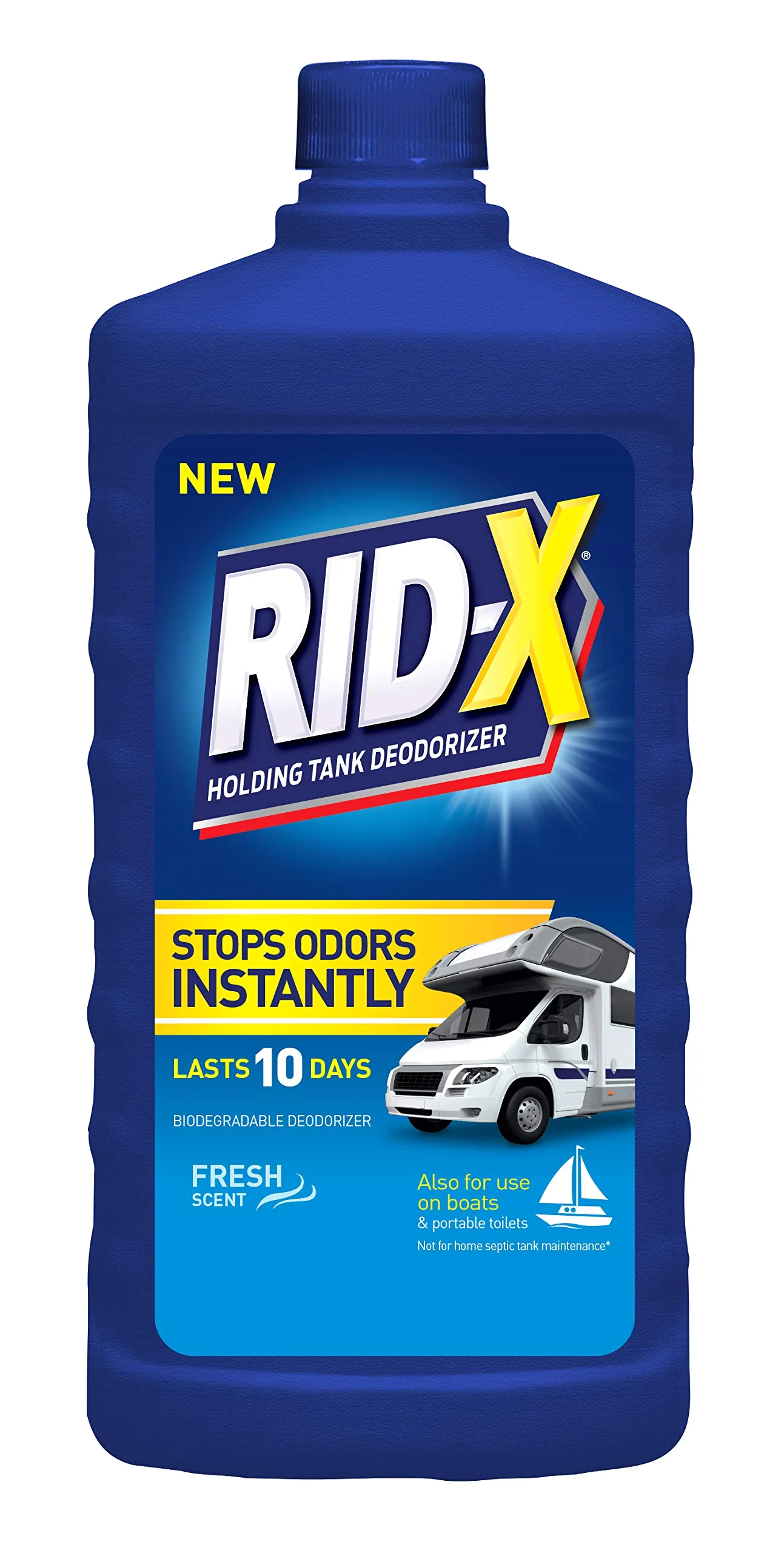
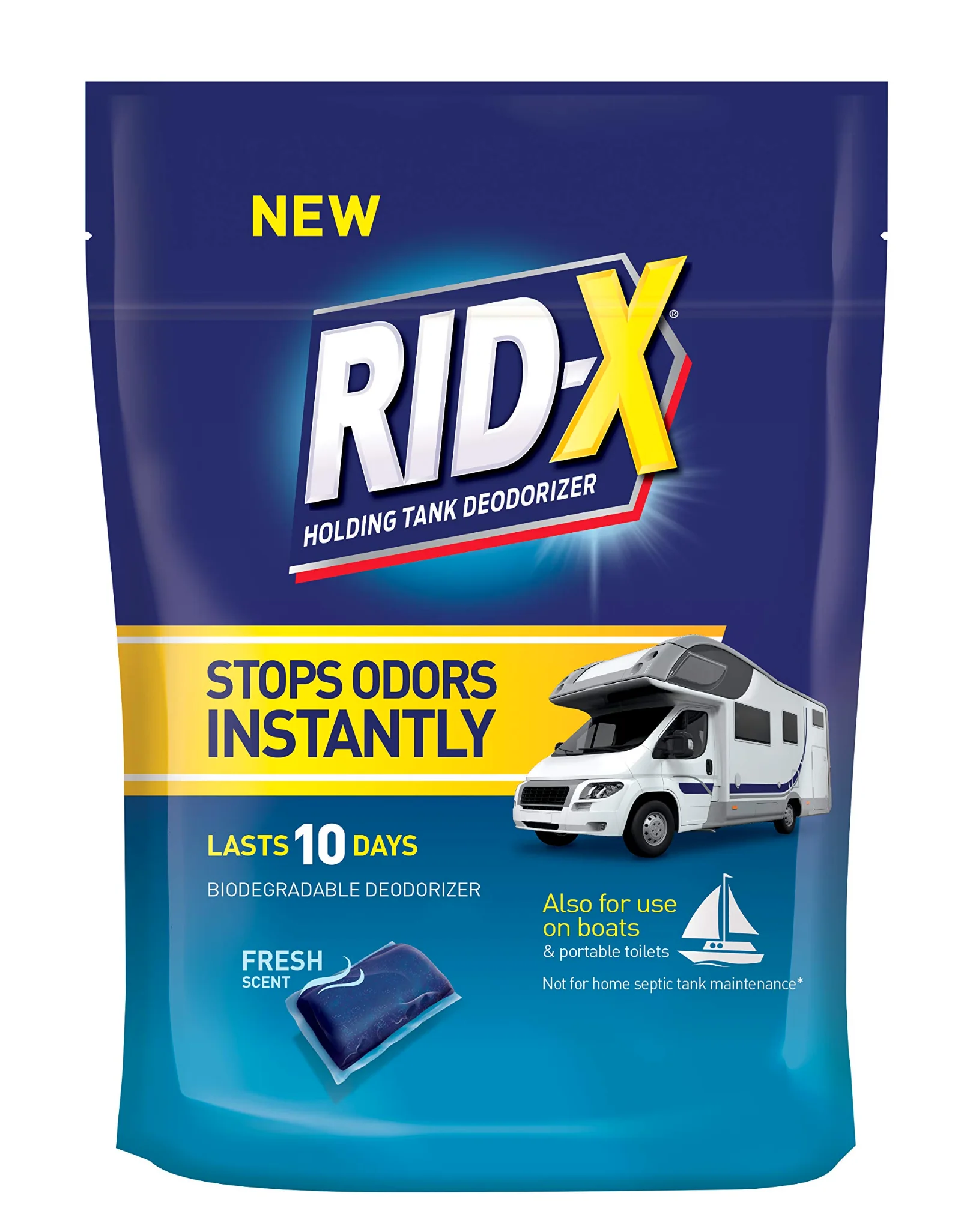
An RV, a boat with an installed toilet or a portable toilet stores waste in a holding tank until you can empty it. Rid-X Holding Tank Deodorizer comes as a liquid, in 24 and 48 fl oz bottles, and as pacs, eight to a box. It is a different product from the monthly septic treatments. Rid-X says it combats odors and breaks down waste and tissue in RV, marine and portable toilet tanks, and that it contains bacteria and enzymes.
The dose is the easy part. The harder questions are where the tank gets emptied and what the treatment does once it reaches a septic system. The EPA's Region 9 alert from 1999 warned that some holding tank deodorizers contain formaldehyde, which can kill the bacteria a septic tank depends on. The University of Arizona's extension sheet tells RV owners to consider only enzyme-based or bacterial-based products. Both papers also tell you to use less treatment, not more.
What you need
At hand
- Rubber gloves
- Sewer hose kept only for dumping
- Separate rinse hose, never your drinking water hose
- Measuring cup marked in ounces
Rid-X products
Step by step
1Read the label before the first dose
- Look for the active ingredients. The University of Arizona lists bronopol, dowicil, formaldehyde, glutaraldehyde, paraformaldehyde and para-dichlorobenzene as substances to avoid.
- Do not take the word biodegradable as proof of safety. Arizona's sheet says it does not necessarily mean a product is safe for people or the environment.
- Never use bleach to treat or sweeten a holding tank. Arizona warns that it damages valves and seals.
2Measure the dose by tank size
- For the liquid, the Rid-X label pairs each tank size with an amount of fresh water: 10 oz with 1.25 gallons for a 50 gallon tank, 8 oz with 1 gallon for 40 gallons, 6 oz with 0.75 gallon for 30 gallons, and 4 oz with 0.5 gallon for 20 gallons.
- For pacs, a 50 gallon tank takes 2 pacs and a 40, 30 or 20 gallon tank takes 1, with the same fresh water amounts.
- Do the arithmetic before a long trip. The 48 fl oz bottle says up to 8 treatments, which matches the 6 oz dose for a 30 gallon tank. At 10 oz for a 50 gallon tank you get four full doses, and a box of 8 pacs covers four dumps of a 50 gallon tank.
- Add no more than the label says. That is also the advice of the 1999 EPA alert for any holding tank chemical.
Tip: Store bottles and pacs out of reach of children and pets, and if anyone swallows some, call Poison Help at 1-800-222-1222.
-
up to 8 treatments
$3.50 per treatment
$27.99 for 48 fl oz

3Run the valves the way Arizona describes
- When you are hooked to a park sewer, keep the gray water valve open and the black water valve closed.
- Dump the black tank when it is half full or more, as the University of Arizona advises.
- Use fewer treatments and dump more often. On the road, rest stop facilities cut how much deodorizer you need, the 1999 EPA alert adds.
4Dump only where the waste is meant to go
- Use an RV dump station, a permitted sewer connection or a licensed pumping service.
- Never empty a holding tank onto the ground. The University of Arizona says so directly.
- Never empty it into a storm drain. Los Angeles County's public health department says dumping on the ground or into a storm drain may contaminate surface water and groundwater, attract vermin or spread disease, and that it violates county code. That fact sheet covers RVs used as temporary housing under a county ordinance, but the health reasons it gives are not local ones.
-
up to 8 treatments
8 pacs
$1.87 per treatment
$14.99 for 8 pacs
5Rinse the tank and stow the gear
- Flush the tank with water after you dump, as Arizona's sheet recommends.
- Rinse with a separate hose. Arizona says not to use the hose you fill your drinking water from.
6Ask before you dump into a home septic tank
- Treated holding tank waste can kill the bacteria in a septic tank and lead to failure, the University of Arizona says, and the sheet extends that warning to municipal systems.
- Los Angeles County allows RV wastewater into an existing septic system only after a qualified contractor confirms the system is in good condition and can take the extra load. That is a sensible test for any home tank.
- If your RV empties into your own septic system, keep that tank on its inspection and pumping schedule. The septic tank pumping schedule and septic-safe habits cover the house side.
Formaldehyde deodorizers and a home septic system
The EPA's Region 9 alert, written in July 1999 for RV, boat and mobile home owners, names formaldehyde, sold as formalin, as the active ingredient in some holding tank deodorizers and calls it a probable carcinogen. It also flags para-dichlorobenzene, found in mothballs, urinal blocks and toilet deodorizers, as a known carcinogen. When a tank treated this way empties into a septic system, the alert says, the chemicals kill its bacteria, solids move out to the leachfield and clog it, and sewage can surface or reach wells.
Read the alert with its date in mind. It quotes a 1957 statement from the U.S. Department of Health, Education and Welfare that no known chemical, yeast, bacteria or enzyme can remove or reduce the solids and scum in a septic tank. The EPA's 2024 fact sheet is more measured: it says some biological additives can reduce scum and sludge, while their long-term effect on the soil is unknown.
On odor products, the newer sources agree with the old alert. That same 2024 fact sheet says odor control products often contain formaldehyde, paraformaldehyde, quaternary ammonium or zinc sulfate and kill the bacteria a tank needs. The University of Kentucky's 2012 extension paper adds that a septic system working properly should not smell inside or outside the house.
Rid-X describes its Holding Tank Deodorizer as a bacteria and enzyme product, which is the type the Arizona sheet points RV owners toward. We have not tested it, and none of the sources we read names it. The ingredient list on your bottle or box is what to compare against Arizona's list of substances to avoid. When RV, boat and mobile home owners look for answers in the EPA's septic FAQ, it sends them to that same 1999 alert.
Boats: Type III devices and no-discharge zones
If your boat has an installed toilet and runs on U.S. navigable waters, the EPA says it must carry a marine sanitation device certified by the Coast Guard. Boats with only a portable toilet are outside that rule. A Type III device is typically a holding tank that keeps sewage on board until you can empty it at a shore-side pump-out or discharge it more than three miles from shore.
In a no-discharge zone, you may not discharge any sewage from the boat, treated or untreated. The EPA says to hold it for a pump-out station or for open sea beyond three miles. To keep a Type III valve shut, the EPA lists closing the valves and removing the handle, padlocking it, or using a non-releasable wire tie. States and the Coast Guard enforce the zones, and the EPA keeps a list and a map of them by state.
The EPA's page on marine sanitation devices says nothing about deodorizers. Whatever you put in the tank, the rules on where it may be emptied stay the same. For the full shelf of holding tank products, see RV and holding tank treatment.
| Holding tank | Liquid | Pacs | Fresh water |
|---|---|---|---|
| 50 gallons | 10 oz | 2 pacs | 1.25 gallons |
| 40 gallons | 8 oz | 1 pac | 1 gallon |
| 30 gallons | 6 oz | 1 pac | 0.75 gallon |
| 20 gallons | 4 oz | 1 pac | 0.5 gallon |
Whether or not a measured dose of the Rid-X line goes in first, the tank still empties at a dump station, a sewer hookup or a pump-out.
Other guides
- Guide 01
How to use Rid-X once a month
Pods, powder or liquid, once a month5 min read - Guide 02
Do septic tank treatments like Rid-X work?
What the EPA and four universities say6 min read - Guide 03
Plan septic inspection and pumping in a Rid-X house
Inspection, pumping and the signs to watch6 min read - Guide 04
Septic-safe habits to keep with or without Rid-X
What to flush, pour, park and plant near a tank6 min read